


Introduction
32.7767° N, 96.7970° W.
Founded in 1841, Dallas has grown into a place that millions now call home. Dallas’ development, geography, and history have uniquely positioned itself as a cultural hub for Texas, and a major economic influence within the United States. With giant corporate headquarters, government agency offices, research centers, a never-ending booming real estate market, and a huge entertainment industry, it’s no wonder why the Dallas-Fort Worth metroplex is consistently ranked as a top contender in domestic U.S. migration trends.
…But how is it that a city with such a tumultuous and transformative relationship with its natural landscape bloomed into such a successful modern urban sprawl? It is through the culture and spirit of Dallas, which are largely reflections of these major manipulations of the natural land and environment, that these realities are possible. These interventions have not only sculpted the city’s physical terrains, and side-stepped its lack of natural resources, but also molded the cultural identities, social behaviors, and economic trajectories for the people who have come to exist through the city.

Dallas’ ventures into transforming its landscapes, from taming flooded rivers, digging lake-sized ponds for vacation homes, and constructing complex concrete currents of traffic aren’t merely infrastructural developments; they are bold creeds of the city’s evolving identity, its triumphs of industry, and its incessant pursuit of control over the natural world. Like so many other cities developing in the United States, there are many parallels to draw to a bigger national narrative, however, I would like to divert these parallels to my own artistic practice and body of work.

In my artistic practice as a new media artist, I look to find physical and conceptual material that lend themselves well to challenge, manufacture, and question “reality.” At the core of my work I explore subtle ways in which technological systems mold the environments around us, influence cultural contexts, and shape identity. I take a multi-modal approach to present dialogues about the evolving relationships between technology and reality, && how we, as humans of Earth, orient ourselves within these spectrums.
As an inner-city Dallas native, I have a deep relationship with this place. My family has lived here for nearly 100 years, so I have been inundated with a flood of personal experiences and histories one can’t find in history books. That being said, my family and I have also lived through many of the events one CAN find in history books—events like The Texas Centennial Exposition, the construction of Central Expressway, the assassination of JFK, and many waves of commercial development.
In this essay, I look at the history of Dallas through major intervention and manipulation of land, broken into 3 definitive movements: Genesis, Construct, Convert. In the first movement, we look at Dallas through a naturalistic lens to get a sense of the flooded flatlands positioned around the Trinity River that the city is built upon- ending on the construction of the levies which enabled an urbanized city of commerce to form. The second movement focuses on early days in the new city starting with the construction of White Rock Lake, and ending with the construction of Central Expressway. Finally, in the last section, we begin by looking at Shingle Mountain, taking note of the intentional segregated city planning then transitioning to Klyde Warren Park with a critical eye, and its influence over the city’s ambitious Trinity River Corridor Project.
By looking through Dallas’ history of manipulation to its natural landscape, I hope to reveal sides of a complex Dallas culture that influences much of the work I do in a broader sense. We will gain a deeper understanding of this history and understand more nuanced elements of the culture that has formed here. This study will also inform and help position my artistic work, and give context to my background as an artist from Dallas.

Genesis
The Earth is a spherical collection of rock.

“The oldest rocks in Texas are in the Central part — the so-called Central Mineral Region or Llano-Burnet uplift — and have been radiometrically dated as three billion years old, long before life in any form appeared on Earth.” – Roadside Geology of Texas (pg. 9)”
With as much assumed geologic history as there may be, a casual 4 hour drive headed northeast from Central Texas leads to a lot of unrecorded natural history until about 1840. Ironically, this lack of natural history, which may be due in part to a lack of significant natural resources, is revealing of the region that has come to be called Dallas, as a major characteristic of the people from Dallas who tend to prioritize business and development over historical and natural precedent.
”“Downtown Dallas: Here the earth is buried beneath concrete and asphalt. The topography is a compromise between what nature provided and what Dallasites wanted. Even the soil is often a purchased item, hauled from one site to another to fill a hole, to make something grow. Only rarely do we actually see bedrock in Dallas, usually in an excavation for a sewer, a road, a foundation….Hence, in Dallas, it sometimes appears that we have actually overcome the influence of the geological environment. We have insulated ourselves from it by all the constructions of man. We have even elevated ourselves above it on piles of our own garbage.”- Planning — A Geological Perspective (pg. 1)
Welcome to Dallas.
Home to 30 species of snakes, 4 of which are venomous: Copperheads, Western Diamondback Rattlesnake, Cottonmouths, and the Texas Coral Snake. -City of Dallas, News Advisory, Park and Recreation Department, “Snake Season is Upon Us”
As snakes navigated, slithered, and twisted their way through the tall grasses of the prairie region so too did many others.
“Fossils identified by Lull(21) in the Union Terminal Terrace provide evidence that giant elephants, mastadons, ground sloths, camels, saber-toothed tigers, and heards of bison, antelope, and horse once roamed the forest and plains of the Trinity River Valley…Radiocarbon dating indicates the artifacts and remains were buried by the flood waters of the Trinity ‘more than 37,000 years ago.’(15)” – The Geology of Dallas County (pg. 37)

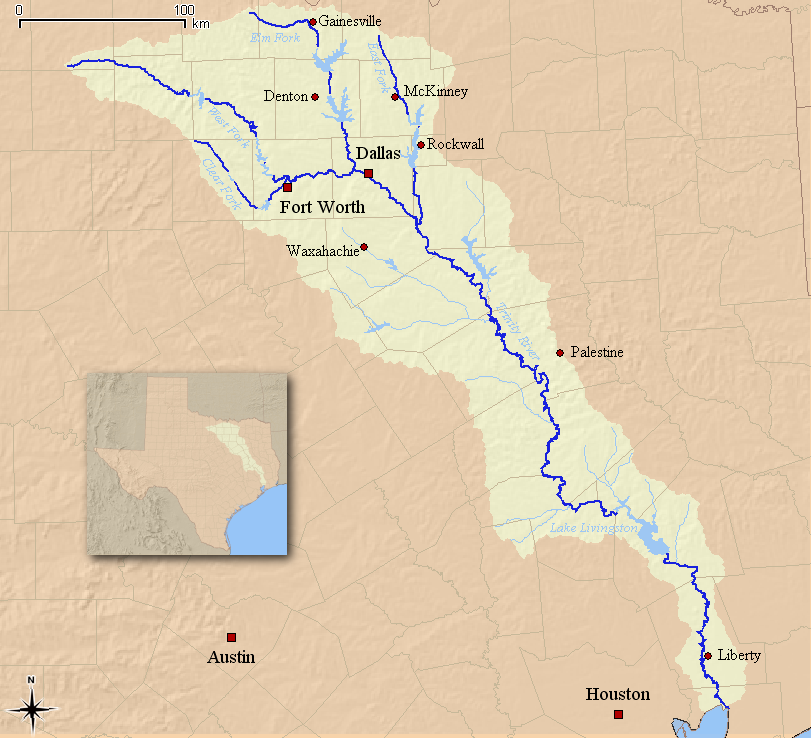
Dallas has naturally been liminal space for liminal life; a place since prehistoric times meant to aid in forms of movement and traversal be it jet streams of weather systems, buffalo migration patterns, or Native American hunting grounds. The flat prairies and flooded lands created these behaviors, making Dallas more of an experience than a destination.
When the real estate lawyer, John Neely Bryan, “re-discovered” Dallas there were visions of the Trinity River being navigable water leading to the Gulf of Mexico – making Dallas a port town; a destination. However,
“An old Texas joke exclaimed that the Trinity River was so murky the fish swam backwards to keep from getting mud in their eyes. Mud also proved to be an obstacle to navigation along with sandbars and snags. Regardless of these drawbacks, persistent Dallas citizens began efforts early to make the river navigable.” – Mud in Your Eye: Dallas Dreams of a Port City (pg. 1)
With mud in their eyes, audacious visions of grandeur continued within the early peoples of Dallas. Decades and dollars later, only 2 boats completed the trek, with many barges and steamboats sinking along the way. Setbacks and failure didn’t stray the leaders from continuing to promote these naturally impossible endeavors – but new technology and business development quickly changed their minds.
So the vision changed, and was largely forgotten.
““When we are in the image of Dallas, we are in the image of land -land without boundaries, flat, expansive, without limits. From the beginning our relation to the land is not one of agriculture, a cultivation of the soil. There is a close connection between the word "cultivate" and the word "culture." In fact, cultivate means culture. This does not mean that Dallas has no culture, but our sense of culture does not come from a tending and caring for the ground, a caring for those who came before us, those who have long since returned to the soil and on whose ground we stand… We continually annihilate the past of this place and pretend that nothing came before us…. To ask the question of culture is to ask what it is that can contain the titanic excess of Dallas imagining…. The founding of Dallas as a real estate development coincides with the establishment of lawyers in order to contain those land transactions. In fact, John Neely Bryan was a lawyer…"He studies law primarily in order to treat with Indians on a legal basis." In addition, Bryan had a close relation to language…. I suggest that titanic expansion is contained through speech, through negotiation, through interpretation. Solid, absolute boundaries are explosive in the Dallas myth. Expansiveness is contained more through trickiness-cunning, like the shifting shape of legal language. If we do not try to relegate all of culture to matters of taste and refinement, then it is possible to see that speech, too, cultivates even when it is speech that is a matter of interpretation.””
- Imagining Dallas (pg. 22-24)
I believe that this quote largely reflects the foundation of what makes Dallas culture unique, and we see these traits permeate from the definitive years of the city’s founding. Using cunning snakey language and tactics- the leaders of Dallas were able to quickly manipulate their language and vision from the efforts of the river, to new efforts in the railroad.
“The original route of the railroad was to miss Dallas by 8 miles. The city’s fathers thought this would be terrible- they must have it come through the city of Dallas, so they went to the railroad officials, petitioned them, offered them $5,000, free right-of-way through the city, and low and behold, won the railroads…. The Houston and Texas Central was just the first of the railroad jewels in the city’s crown. The next year, builders of the Texas and Pacific Railroad tried to bypass Dallas, but local politicians slipped a tricky clause in a bill saying the new line had to cross within a mile of Browder Springs, only later was it discovered that Browder Springs was located at City Park. Dallasites had themselves another railroad” -Bid D Back When, KERA (13:30) https://www.youtube.com/watch?v=p-n5-8giHfo&t=2409s&ab_channel=KERA
The railroad technology brought the first big wave of people into the pioneering town – evolving the small town into a city. In this origin story we see the founders cultivate the winding flood lands, harvesting not natural riches, like most major developments usually do, but instead cultivating a snakey culture of language, trade, and perception, intertwined with the serpentining bends of the muddy river. The miles of steel now laid through the land solidified Dallas as a destination, no longer just natural liminal space for travel [and it’s interesting that Dallas today is still a major hub for transportation]. The new reality of Dallas had been created, and was now being promoted as a boomtown. However, as the city’s population doubled, tripled, and quadrupled, Dallas still couldn’t quite escape it’s true nature.
As the city grew with excitement about the railroads and new financial freedoms, the river reasserted itself in a very violently natural way.

”“The Great Flood of May 1908 cut off Oak Cliff (the farther shore) and did millions of dollars worth of damage to railroads, streets, bridges, and industries. The Commerce Street bridge, above, was washed out on the western end and so was the streetcar trestle”
- Dallas: The Deciding Years - A Historical Portrait (pg.114, 115)

Floods were a recurring nightmare, with waters often spilling into downtown commercial areas flooding businesses and homes. Dallas needed to do something to maintain its reality of a growing boomtown, otherwise it wouldn’t survive.
“The disaster was an embarrassment for young, up-and-coming Dallas, and the Chamber of Commerce swung into action. In 1909, the chamber established the City Plan and Improvement League, which invited city planner George Kessler to come to Dallas and propose fixes. When Kessler arrived in Dallas, he found a messy tangle of streets, railroad tracks, depots, and disconnected neighborhoods, the result not of careful city planning but of growth driven by opportunist land speculation. Kessler, like Bryan, viewed the Trinity River as both an obstacle and an opportunity. He proposed moving the river away from downtown and confining it within levees… ” – https://www.dmagazine.com/publications/d-magazine/2017/march/wild-dallas-trinity-river-guide-dallas/taming-the-trinity/
And so a new vision was had for the city and the new technology to enable it. In response to an earlier quote from “IMAGING DALLAS”,
“To ask the question of culture is to ask what it is that can contain the titanic excess of Dallas…”
…a system of levies to contain the central life force of the city — containment of the Trinity River.
“The Kessler River Plan would move the riverbed to the west into a more linear alignment, relocate the confluence of the Elm Fork to the West Fork three miles to the west, and build high levies on both sides of the river to protect over 10,000 acres of land from future floods.”
–https://www.youtube.com/watch?v=GQ6PoGXLTQ4&ab_channel=LynAbercrombie

Directly quoted from Kessler:
“The Trinity River bottom, with its wide flood area, together with the railroads on its left bank, strongly illustrates the barriers surrounding the business district of Dallas. On the west of the river, within ten minutes walking distance of the highest valued lands in the city, is a great area having practically no more than farm values, upon which a great city will spring up immediately upon the construction of one or two more highways safely above floods and railroads. The river, instead of remaining upon the western border of the city and a constant menace to it, would in such case, become nearly the center of a great city, with Oak Cliff and West Dallas integral parts instead of segregated units.” – Kessler (pg. 6) https://texashistory.unt.edu/ark:/67531/metapth207135/m1/10/
Dallas wasn’t the only area to begin implementing Kessler’s transformative vision upon the Trinity River. Fort Worth was following suit, building dams and spillways to contain the same natural elements. In Clarence Sale’s 1957 thesis submitted to the Graduate Faculty of Texas Christian University, Sale goes into depth about Benbrook lake’s geology, before the outcrop in the area was covered with water. Through this work, he shares photographs of some of the technological equipment used to excavate the soil, including an early drag-line excavator, one most likely used in the construction of the Trinity River levies.
“25 miles of levees were built, 30 feet high, and 156 feet wide at the base. 8 Drag lines operated non-stop to create a floodway 2,000 feet wide. The Trinity River would never be the same. With the levee system underway, Leslie Allison Stemmons convinced land owners to pool their property to develop a modern industrial park on reclaimed land. Industrial Properties Corporation was formed to get it done. On an inspection tour, Mr. Stemmons pointed to a place, which today is the intersection of Commerce St. and Industrial Blvd. and predicted that this would someday be the busiest intersection of Dallas…. In the 7 and a half decades since, the 1500 Trinity Industrial district has been developed into a vital part of the Dallas business community. ”https://www.youtube.com/watch?v=GQ6PoGXLTQ4&ab_channel=LynAbercrombie

Spoiler alert:
””The next two decades of construction made some men rich. The area where the Trinity River once flowed became known as the Trinity Industrial District (later renamed the Design District), and from the Trinity’s muddy bottoms John Stemmons and his real estate man, Trammell Crow, went on to build what was by the 1980s the largest real estate company in the world.”
-https://www.dmagazine.com/publications/d-magazine/2017/march/wild-dallas-trinity-river-guide-dallas/taming-the-trinity/
As the mud in the eyes of early Dallas visionaries washed away from the floods, it hardened into cement. This metaphorical and cultural symbol of concrete, quite literally, was used to pave the roads into the next chapter of Dallas.

Construct
Part 01
In the early days of the now City of Dallas, and the river, in the process of being tamed, reality seemed as malleable as the wet cement that was being laid into the city’s new foundations. It’s physical foundations, and cultural foundations.
“Cement City was a small town in West Dallas created to support workers in the cement plants operated in the area. The town was situated on the Texas & Pacific Railroad line, just north of the La Reunion lands, about three miles west of the Dallas County Courthouse.
During the 1880s, former La Reunion colonist Emile Remond bought a parcel of land north of the old colony and began experimenting with the rich deposits of chalk, limestone, and shale he found there… This was the first cement company in North Texas, beating the Trinity Portland Cement Company in nearby Eagle Ford by one year… In 1908 the Texas Portland Cement Company acquired the plant from Iola and announced plans to expand the plant and production. Part of their plans included creating a town, and they incorporated the city of Cement on 28 April 1908. A Post Office opened in 1907, and stores, schools (Cement City Independent School District formed in 1911), and other services sprang up to support the families of cement workers now living in houses built and owned by Texas Portland Cement Company. The city’s population reached 503 by the 1910 Census…” https://dallaslibrary2.org/dallashistory/archives/MA04-9.php

Cement City encapsulates the dichotomous “un-nature” of Dallas’ evolution. While this mud-based technology served as a beacon of progress and development through construction, churning out the building blocks of the city, it also proved the human cost of industrialization — a space where culture, history, and people were consumed by the dust of production.

“The company needed workers, and many came from Mexico, some fleeing the Mexican Revolution. Others heard that there was work in this part of town after previously working on the railroads laying tracks. Eventually, the company constructed segregated housing for its workers. One village was designated for African Americans and Mexican Americans, while the other one was for Whites.”
“One village was for whites. The others—Campo Grande, Campo Chico, and Eagle Ford—were for Mexicans. Before Little Mexico became a center of Dallas’ Mexican community, only to get displaced by what is now Uptown, these were among the city’s other original barrios. Those barrios were around Cement City because Mexicans helped make the substance that became the literal foundation for Dallas’ growth.”
https://www.dmagazine.com/publications/d-magazine/2019/december/the-ghosts-of-cement-city/
“The workers in Cement City experienced dangers, and the work was bone-breaking. Additionally, the community faced several injustices. The cement factory produced dust and fumes, which contaminated their water. They also faced discrimination, much like other communities of color. Despite facing adversities, the families in Cement City made it their home. Eventually, the company headquarters moved away, and today the only remaining structure is a small cemetery behind an AT&T building.”
In typical Dallas tragedy, history is replaced by a parking lot, and as we know from an earlier quote:
“our sense of culture does not come from a tending and caring for the ground, a caring for those who came before us, those who have long since returned to the soil and on whose ground we stand… We continually annihilate the past of this place and pretend that nothing came before us….”
In “Faces of Cement City,” a collaboration between Teatro Dallas and Tropic Pictures, we hear and see the late personal account of Henry Martinez Sr. from Eagle Ford, TX (the Mexican village established in Cement City):
“My mother is buried in Pinnacle Park. And my sister, and my uncle, and a lot of my family are buried at Pinnacle Park behind the AT&T parking lot. I want to go there to be buried, also. If they let me… ”
Shortly after seeing this personal account:
”Henry Martinez, Sr. died shortly after this interview. His wish to be buried at El Campo Santo De Cemento Grande was not fulfilled”

Miles away from the fumes of Cement City – luxury could be inhaled. As Dallas rose in stature, the concrete from Cement City laid the ground for iconic Dallas institutions like Neiman Marcus. Established in 1907, this beacon of commerce and luxury was more than just a store; it was a symbol of the city’s rising affluence and ambition. Neiman Marcus offered an experience that transcended shopping, enchanting the elite with visions of European elegance and fashion amidst the rugged Texan landscape. The air was perfumed with royalty, creating an aura that seemed untouchable for those who laid its foundations.

In parallel, majestic theaters like The Majestic, the Melba, and the Palace illuminated the Elm Street strip with marquee lights that drew crowds eager for escape. These temples of drama and music stood as pillars of the city’s cultural aspirations in search of sophistication, identity, and temporary history. Dallas flocked to these venues, wrapped in the latest fashions from Neiman Marcus, basking in the glow and glamor of the “cultural enlightenment” that Theater Row sold.
This new Dallas bourgeois found themselves in the center of southwest trade, enabled through the railroads, lessons learned in tricky language, and newfound opulence through concrete — a blossoming culture’s new era of luxury and leisure began. Having just tamed the violent and unpredictable Trinity river, the confident people of new Dallas saw no bounds when yearning for a leisurely lake-side retreat.
Originally constructed in 1911 in response to Dallas’s increasing demand for water, White Rock Lake was strategically planned.
“City leaders decided to impound White Rock Creek to create a new lake about 10 miles northeast of town. In 1909, city commissioner of streets and public land William Doran and purchasing agent M. H. Mahan began purchasing the farm and forested land along White Rock Creek. By March 22, 1910, they had purchased 2,292 acres of land at a cost of $176,420. The city engineering department drew up the plans for the dam and pump station. Fred A. Jones Company received the construction contract for the dam and spillway on March 8, 1910…. Everyone anxiously waited for the water to rise, but because of the continuing drought, the lake did not fill until April 14, 1914, at which time the water was 42 inches deep over the spillway. The foundation for the pump station was poured during construction of the dam and spillway. In November 1910, construction for the new pump station was contracted to Hughes O’Rourke, and it was completed in 1911. White Rock Lake was gauged to hold 5.8 billion gallons of water, which was enormous at the time compared to the less than one billion gallons held on the Trinity supply. White Rock water was the first chlorinated water in Dallas. It was not clarified or filtered, but chlorination was a giant step forward… Dallas continued to grow, and before too long, the city limits extended out to White Rock Lake. The new growth also meant an increased demand on the water supply. City leaders originally believed that White Rock Lake could be the major source of water for Dallas for 100 years, but by the mid-1920s, the need for water surpassed the supply provided by White Rock. In 1929, a new, larger lake was completed further north in Lewisville, Texas, and White Rock Lake was no longer needed as a water source.” -White Rock Lake, Rodriguez

This material expression of cement, enabling the containment of water at scale, was not just a feat of engineering—it was the embodiment of Dallas’s burgeoning aspirations. The creation of White Rock Lake was a testament to the city’s ability to shape its environment to fit its desires, and not succumb to the conditions of nature. No longer just a practical response to water needs, the lake transformed into a symbol of leisure and affluence for the city’s middle and upper classes.
The shores of White Rock Lake evolved into a picturesque landscape. The city’s elite, having laid the foundation of their wealth in the heart of Dallas, now shifted focus to enjoy the fruits of their labor in a more serene setting. The lake’s waters and expansive views offered an escape from the urban bustle, a place where Dallas could indulge in the tranquility and recreational activities that were once the exclusive right to far-away places.

Boating, swimming, fishing, and picnicking became popular pastimes at White Rock Lake. The construction of boathouses and sailing clubs around the lake’s perimeter further accentuated its status as a premier recreational destination. These facilities were not practical structures; they were symbols of lifestyle, a Dallas identity, and statement of cultural shift. Sailing clubs like the Dallas Sailing Club, founded in 1935, became hubs of social activity, bringing together the city’s affluent to enjoy leisurely afternoons on the water, far removed from the industrial efforts that had characterized Dallas’s earlier years. The city, rapidly transitioning from a frontier town to an urban metropolis, was keen to showcase its cultural and recreational credentials.
Part 02

The instinctual urge to showcase and promote, while built into the core of Dallas’ founding, was particularly visible in one Dallasite – Robert Lee Thornton Sr. This new spirit of Dallas was bolder and richer than before, and R.L. Thornton was just the character to push this new Dallas to a larger stage.
“Thornton had come to Dallas to open a storefront banking operation appropriately named Mercantile. If his little bank was to grow, Dallas had to grow. And R.L. Thornton wanted his bank to grow in a hurry. He took his idea to the most influential Dallasites of the era, Nate Adams of First National and Fred Florence of Republic. They both thought he was off his rocker. Thornton’s idea was to hold the centennial celebration of the 1836 Texas Revolution in Dallas… ..He convinced them to call together a meeting of the ‘yes and no men’ of the city. In Thornton’s parlance, a ‘yes or no man” was a person who in a meeting could commit his company’s or his family’s fortune to an enterprise without having to get anyone else’s approval. The first official meeting of the Dallas Citizens Council was held, and Thornton talked them into backing his venture. He painted visions of the millions of visitors who would descend on Dallas, of the thousands who would decide to stay, of the publicity that would catapult Dallas into international prominence, and, not incidentally, of the money that would be spent. He then headed for Austin.”
In an oak-paneled room at the State capitol, representatives from Austin, San Antonio, Houston, and Dallas presented to a committee of the Texas Senate in efforts to win the site selection for the Centennial. After emotional and historical motivations for each city — Austin (central geography and State Capitol), San Antonio (The Alamo), and Houston (Victory of San Jacinto and a $5,000 pledge from citizens) it was Dallas’ turn to present.
“It was at that point that R. L. Thornton got up to make his argument on behalf of Dallas. He had a weak case, he knew it, and he was prepared for it. “I’m not here to talk about the past,” he almost shouted into the microphone, “I’m here to talk about the future. The future is Dallas, Texas. The citizens of Dallas have given me this check for $300,000 to establish the centennial exposition. Take it or leave it.” There was a stunned silence in the room. The gavel banged, the vote was unanimous, and Dallas got the centennial exposition. Eight months later Fair Park was built, the centennial was a roaring success, and the term “Big D’ was born. Dallas, by the way, made a bundle.” – Imagining Dallas (pg. 31-32)
This moment marked the co-sign of Texas legitimizing the Dallas ethos that would be introduced to the rest of the country and world. “The Future” didn’t end with the Texas Centennial, R.L. Thornton (after finding success in the auto loan banking business) kept his foot on the gas, going on to become a four-term elected mayor of the city, steering Dallas through an era of infrastructural metamorphosis, and finally being im-mortar-ilized as one of many freeways in one of the world’s most extensive freeway networks.
With new visions of the future, and again, in typical Dallas fashion, it was time for old technologies to be replaced, and paved over with concrete.

”“The first proposal to remove the railroad was the Kessler Plan of 1911 which recommended building Central Boulevard on the railroad alignment. Southern Pacific Railways proved to be a tough negotiator and Dallas officials spent the next thirty years trying to reach an agreement for the purchase of the railroad. On June 4, 1941, a contract was signed for the purchase of the H&TC railroad right-of-way for Central Expressway. Plans for the freeway were placed on hold due to World War II, but in 1947 work was underway and the H&TC tracks north of downtown were dismantled.”
- http://dallasfreeways.com/dfwfreeways/pdf/Dallas-Fort-Worth_Freeways_book-20140803.pdf

Before R.L. Thornton, aka Mr. Dallas, became mayor after his stint as President of the State Fair – the city’s acting mayor was James Woodall Rodgers. It was through the efforts and influence of Woodall Rodgers that Dallas had its first freeway, Central Expressway. On August 19, 1949, a crowd of 7,000 people gathered for the opening celebration of the first section of the newly built freeway.
In less than a decade, Central Expressway had already enabled growth and commerce at break-neck speeds (with no help from the dangerous on-ramps). Not only did it prove itself and inspire a handful of additional freeways such as Interstate 35E North Stemmons Freeway (named after Leslie A. Stemmons, the leader of Trinity River Levees), Interstate 635, Lyndon B. Johnson Freeway, and Interstate 30 East, Robert L. Thornton Freeway, Central Expressway enabled the excess of expansion to more technology and more real estate.
Highway 75 (Central Expressway) was extended through Richardson, Plano, and eventually Van Alstyne. Along the way, the Meadows Building was constructed (1955), historically significant, and surprisingly still with us, as the first major office building outside of the central business district, symbolizing the ability for work in the new mid century American suburbs that would soon surround, consume, and extend out to Fort Worth, giving rise to The Metroplex.
Another historic and majorly significant milestone, for a city obsessed with visions for the future, along this stretch of road, and just north of 635, was the invention of the world’s first integrated circuit at the Texas Instruments Semiconductor building. Built by Jack Kilby in 1958, the integrated circuit, or the microchip, would go on to become the foundational technology powering the world’s electronics and computers decades later.
Yet, as the city raced towards progress on top of the new freeway network, “The Future” wasn’t felt by all of Dallas’ races. The concrete currents were moving white traffic and white economic activity north, dividing the city, and neglecting marginalized and underrepresented peoples, and this wasn’t just ignorant coincidence.


““This [segregation] didn’t happen by accident,” said Mike Koprowski, who worked on the new Dallas housing policy before moving to Washington this year to serve as national campaign director for the National Low Income Housing Coalition, an advocacy group.
“This was engineered by the government at all levels,” Koprowski said.
Indeed, the city’s long history of segregation dates to the post-Civil War era. But the architecture of its segregated communities was crafted in the 1940s, by an urban planner from St. Louis, Harland Bartholomew, whom city officials hired to do something about the city’s black population.
Bartholomew created so-called Negro districts cut off from the rest of the city, districts that bumped up against levees and heavy industry. Black families who bought homes outside those confines didn’t get to keep them for long. Bombings were a regular occurrence in Jim Crow Dallas — crimes that went unpunished.”
https://stateline.org/2018/10/03/this-city-wants-to-reverse-segregation-by-reviving-neighborhoods/
Reality check — The city was so racist, that when President John F. Kennedy, a major influencer of the Civil Rights Movement, visited Dallas on November 22, 1963, he was assassinated in the heart of the city, broadcasted for the world to see— something had to change.

Convert
Unfortunately things haven’t changed for everyone.

“Marsha Jackson didn’t go to the mountain. The mountain came to her. From her home in south Dallas, she watched it grow until it towered at 60 feet tall and spread all the way to her backyard, “a few feet from my bedroom.”
The mountain is human-made — an environmental nightmare of discarded roofing shingles stretching more than a city block. Even though it’s an illegal toxic waste dump on the edge of a neighborhood, it took months of pressure to get city officials to even acknowledge its existence and finally make plans to take it down.”https://www.washingtonpost.com/climate-environment/2020/11/16/environmental-racism-dallas-shingle-mountain/
Unfortunately things haven’t changed for everyone.
Shingle mountain represents another example of the permeating darkness in the city’s culture. Created from nearly 60,000 tons of recycled shingles, the toxic mound was designed by Blue Star Recycling company in attempts to collect old roof tear-offs, and avoid having the materials pollute standard landfills. Instead, they would collect the material on private land, right next door (literally) to residential neighborhoods, shred the shingles, sending glass fiber and formaldehyde into the air (and into the lungs of the neighborhoods), melt the shreds into tar-like goo to fill potholes in roads (to sell), and do so while selling a premium convenience to truckers hauling shingles looking for alternative more convenient places to dump.
“A recently released TX Commission on Environmental Quality (TCEQ) inspection report noted Blue Star had a state permit for storing only 280 tons of combustible waste and promised it wouldn’t keep any waste on-site for more than a week. As of the November 2018 inspection, the company reported 60,000 tons of waste on-site, most of which had been sitting there for the better part of a year.”
https://www.youtube.com/watch?v=5QmhmBOAwwE&t=1s&ab_channel=DownwindersatRisk
Just like Cement City, over a century before, we see similar artifacts and consequences from this Dallas spirit. This isn’t just a pile of shingles, as it wasn’t just a concrete factory; it’s a stark reminder of how progress can cast a big, dark shadow – sacrificing human life for the sake of a dollar. It’s the flip side to the American-Dallas dream, where the rush for growth and prosperity leaves a trail of neglect and disparity, as it must for the sake of capital. The city’s manipulative facade of glittering LED skyscrapers and sprawling tollways filled with cars that cost more than houses, sheds light on a grim, divided, toxic, classist, and racist reality that most of the people who actually live in the city limits must face.
”“It could not be more crystal clear,” said Chris Dowdy, the vice president for academic affairs at Paul Quinn College, a historically Black university in south Dallas that participated in a study called “Poisoned by Zip Code.” “You can draw a straight line from where Black folks gathered after emancipation to the redlining maps, to where you’re more likely to be poisoned because of zoning, and where people die earlier.”
https://www.washingtonpost.com/climate-environment/2020/11/16/environmental-racism-dallas-shingle-mountain/

We stand at a juncture in Dallas’s contemporary narrative—from the tragic assassination of President John F. Kennedy, an emblematic influence of civil rights and social progress, to the cancerous rise of Shingle Mountain, a testament to environmental and community neglect, half a century later. Dallas, once celebrated for its daring infrastructural feats, technological invention, urban-cowboy fashion, and real estate achievement, now confronts the task of reconciling its ambitious past with the need for sustainable and equitable growth for all of its communities.
But how does the traditional spirit of Dallas, one so gung-ho about racing into the future at all costs, looking past and through natural obstacles, a spirit that intuitively manipulates it’s environments to create the reality it wants, slow down, reflect, and take into consideration more perspective and awareness?
Well, initiatives like Klyde Warren Park might be a step in the right direction.
The park appears to present a shift in the city’s approach to urban development—one that intertwines concrete with green, the architecture with something a little more “natural”, make amends with its community-displacing past, and most importantly claims to prioritize access and community. However, the park can’t help but to do these things in a very Dallas-way.
Klyde Warren Park (named after the primary billionaire banker/donor’s grandson) isn’t just a centrally located urban green space, right across the street from the Federal Reserve Bank, it is a 5.2 acre “deck-park” located in the middle of Downtown Dallas quite literally, bridging Uptown with the Dallas Arts District. Seemingly suspended over Woodall Rodgers Freeway (Highway Spur 366), the park spurs urban regeneration as the city’s traffic drives underneath, in awe of the iconic high-tech green park floating above them. The park has an annual budget for daily community programming, hosts many events and festivals throughout the year, and has an impressive attendance turnout, by many means, successfully transforming the area, and image of Dallas.
On the surface, the facade of the park feels like the future – redefined again. But it’s a peculiar coincidence that the park has also increased real estate value in the area tremendously, and feels like the same spirit of Dallas we see over and over again – just with new technology and language.
“Dallas’ Klyde Warren Park is an economic development success story touted within the cap park movement that has expanded the revitalization of the downtown business and arts district and transformed a blighted freeway corridor into a regional arts, leisure, and cultural destination. This success was enabled by substantial investment by business interests and developers and represents an extension of long-term revitalization efforts that began when African-Americans and Mexican-Americans were displaced during freeway construction. The park’s environmental amenities were largely promoted in service of economic development goals, which dominated the sustainability discourse surrounding the park’s planning process. Likewise, equity concerns were cast in the shadow of economic development. For instance, a business leader observed that Klyde Warren Park “rights” a lot of “wrongs” caused when freeway construction isolated the central business district by providing “the type of urban environment that companies and people are hungry for today” (Perez, 2012). Even as she recognizes the historic injustice of freeway construction, this leader quickly dismisses the feasibility of more broadly addressing environmental and equity concerns and shifts focus onto how the park enhances the area’s marketability. The development boom near Klyde Warren Park, however, has spurred concerns over environmental gentrification, housing affordability, and displacement of long-term residents and businesses in the area, but the city has taken only modest steps towards addressing these concerns.”

But at least Dallas is trying?
The Trinity River Corridor Project is another contemporary grand vision for Dallas and Trinity River, similar to early visions centuries ago. Coming full circle, the ambitious project aims to revitalize a sprawling area around the Trinity River, transforming it into an ecological and recreational hub. Taking lessons from Klyde Warren Park, the Trinity River Corridor Project is an attempt to connect the city with “nature”, to heal and connect rather than divide and isolate. It’s an acknowledgement that the future lies not just in the ability to expand, but in the ability to nurture and protect.
As stated from the official Trinity River Corridor Project website:
“The Trinity River Corridor Project is one of the most monumental public works and economic development projects ever attempted. As flood protection, recreation, environmental restoration, economic development, and major transportation components converge along the Trinity River, and thousands of residents and visitors from around the world are experiencing this new and exciting destination within the City of Dallas.
Dallas’ glittering image is redefined by the many different aspects of the Trinity River corridor including wildlife habitat, wetlands, trails, the Great Trinity Forest, and amazing recreational facilities such as the Trinity River Audubon Center, Texas Horse Park, Trinity Forest Golf Club, and Ronald Kirk Bridge and Felix H. Lozada, Sr. Gateway.
These “wild” areas and amenities are the framework stimulating a new style of urban development. Already, stunning condominiums and townhouses, modern office towers, and a variety of outdoor dining, and retail options have sprung up on both sides of the Dallas Floodway…. The Trinity River Corridor Project covers 20 miles or approximately 10,000 acres along the Trinity River.” https://trinityrivercorridor.com/about

Beneath the glossy green surface of astroturf, lie deep-rooted critical questions. Is this just another chapter in Dallas’s long tale of dressing up aggressive expansion in manipulative eco-friendly ethical language? Is this real and genuine environmental/community stewardship, or just another calculated move by the city’s elite to ensure a future financial stronghold over the city, and the millions of new arrivals moving in from all over the world, displacing the local Dallas-natives who have been here for generations? It’s hard to say, especially when looking at the patterns of the past and trajectories for the future.
We do know that Dallas is a city in constant flux – as it always has been; reflecting a broader national image into its own visions of grandeur. Like the larger United States, Dallas rushes headstrong into the future of fashions, often stumbling over exploited communities to achieve broad swathes of progress, leaving finer details like equitable community development and environmental justice blurred in the past. But in this same spirit of constant reinvention, there is unlimited potential to see Dallas change into a place that represents the ideals its communities want to see – be it genuine or a gimmick to raise money.

Reflections
As an artist from Dallas...
As an artist from Dallas, I have a sensitivity to a particular fume, a scent that alters perception and reality through a unique exploitative blend of ambition, technology, and language. This aroma, a byproduct of the city’s character, pervades its concrete expanses, luxurious places of leisure, and urban green spaces masquerading as nature. This is the atmosphere I was born and raised in, fostering an intuitive complex with my environment that is as skeptical as it is contemplative, curious, and excited with opportunity.
At the heart of my practice lies the dichotomy between reality and nature. Nature is a collection of universal laws, forces, and patterns true in unaltered existence. In contrast, reality is a nebulous social construct formed through various technologies and perspectives. It’s within this spectrum where my art is found, exploring the edges of nature’s inherent universal truths and manmade interpretative realities — reflecting audiences’ assumptive reality.
My definitions, philosophy, processes, and approaches can be compared, inspired, and aligned with those of Martin Heidegger, John Latham, Hito Steyerl, and even Duchamp, applied in practice similar to Nam June Paik, Nicolas Bourriaud, Jean Baudrillard, internet art duo, JODI, Beeple, and Refik Anadol. In other words, I take a Heideggarian perspective to “being-in-the-world”, through ritual events, or “least events”, with critical understanding of technologies and the “Bubble Vision”’s they can create, fashioned by attitudes and expressions that can be seen through works like, Fountain, The Bride Stripped Bare by Her Bachelors, Even, or Nude Descending a Staircase, No,2. These perspectives in my work can be seen in form through video sculpture (Paik), ai renderings (Anadol), playful web experiences (JODI), and relational art, all with intentions of confronting reality and simulation.

My work typically starts with technologic systems like Artificial Intelligence or social technologies like culture, language, and politics, where perception is manufactured by conceptual processes and frameworks. Provocatively playful, I find moments, gestures, and assemblages where paradoxes and glitches in these technologies may exist. Once I discover these borders, I look to material and the behaviors of surface/facades as means to reinforce these moments: video art sculptures draped in “artificial flesh” made from gelatin and honey, or an oil painting, created via contracted labor in China, propped on an easel belonging to Joe Grandee. As form follows function, function follows reality.
In Aesthetics of Real, a body of various artworks, I present audiences with technologic processed residue that chip away at assumptions of reality—the primary assumption being that reality is true, or an accurate, objective reflection of nature. Nature is only fleetingly experienced when an awareness or assumption is challenged or broken and it is gone the moment that feeling is interpreted. This interpretation, facilitated by the artwork, is a realization of truth & nature, thus removing “the event” from nature, and biasing it in a human constructed social reality. For instance, In a series called, Water Wars, audiences appear to be confronted with A.I. generated artwork taking form as traditional fine art: framed prints, illustrations, sculpture, etc. ..and on the surface they are. But in these works’ “thinginess” they perform an ambiguous critique about A.I. ‘s role in fine art, and a plastic culture of leisure, beauty & surface-level aesthetics enabled by this technology and form.
For me, art isn’t simply a mimesis of the objective singular world, but a means to question, create, and play within it. Perception is active creation, a dynamic relationship of observation, interaction, and interpretation. Through this understanding, my artistic work challenges and reshapes perception as “realities” that can be manufactured, altered, and discovered.

Conclusion
In summary,
In summary, much of my artistic practice is in direct response to the Dallas environment and culture I’ve been immersed within since the early 1990s. That’s not to say that much of the work I do is about Dallas, but more so that much of the skills, perspective, media, and strategies I implore are things I’ve needed to learn and adapt to as an artist operating within this local environment. In this essay we’ve seen a particular side of Dallas that illustrates a piece of urban America, with a Texan sized snakey twist.
This trip through Dallas’ past isn’t just a historical view, but a realization of the city’s spirit and culture, defined by its tumultuous relationship with its natural environments, and ability to manufacture the reality it wants. From the taming of the Trinity river to the sprawling luxuries of the freeway network, buried deep beneath the formaldehyde of Shingle Mountain, and back into the greenwashed layers of astroturf at Klyde Warren Park – this is Dallas, and its clear to see why Dallas is still “America’s Team” (even though the Dallas Cowboys haven’t won a championship since 1998.)
It is an enigmatically culturally rich city that has informed not just the way I see the world, but how I choose to represent it through my art. Requiring more than just a keen eye for detail, to understand Dallas also requires an ability to see the big picture, and the ability to read between some lines, and to also understand challenging trajectories into the future. As the rest of the world continues to move to Dallas, (and Texas) to enjoy the excessive expanse, my art will continue to capture these dynamics in classic Dallas-fashion.
Earlier this year, I attended an exhibition at the Nasher Sculpture Center, ‘Groundswell: Women of Land Art,’ and was deeply inspired by the experience. In retrospect, I realize why this was such a successful showcase: it mirrored the very essence of Dallas itself, rooted in the manipulation of land. The exhibition’s exploration of the relationship between art, land, and perception resonated with me, encapsulating very similar themes I grapple with in my work. The way these artists engaged with and transformed the physical landscape, using it as both a medium and a message, reflects my own motivations to present technology’s effect on environments and realities. The subject of this paper was largely inspired by that show, and I’m grateful for the opportunity that Dallas has given me to collect these thoughts into this format.
✌️